HISTORY

McLagan was a Stratford, Ontario furniture-maker that expanded into cabinet disc-phonographs (gramophones) in the early twentieth century. The business traces back to Porteous & McLagan (1886) and later operated as the McLagan Furniture Company (often cited as founded 1896, with George McLagan sole owner from 1897). Its main factory was on Trinity Street in Stratford, commonly listed as 93 Trinity Street, with period directory references also showing the phonograph corporation at 92 Trinity Street.

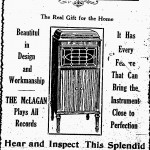
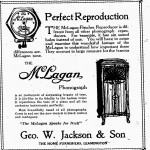
McLagan’s phonograph market entry was 1916, when McLagan Phonograph Corp. Ltd. launched “more than a dozen” floor models and promoted them as high-quality cabinet machines, typically using imported mechanical components and differentiating through cabinetry and features such as the McLagan-Fletcher tone arm/reproducer. Launch-era model names documented in surviving advertising include Louis XVI (M-19), Queen Anne (M-25), and Adam (M-41), treated as 1916 entry models. A later named product, the “Phonothetic McLagan,” is documented in advertising dated 1926.

The clearest end marker in local Stratford sources is 1937, when the Trinity Street plant ceased McLagan use and the furniture operation is reported as closing, making 1937 the best-supported “defunct” year for the McLagan enterprise at its primary site.

McLagan Phonograph Corp. Ltd.

92 Trinity Street
Stratford / Canada

MODELS

M 17 (Modern Style)

M 19 (Luis XVI Period)

M 23 (Modern Style)

M 25 (Queen Anne Period)

M 27 (Queen Anne Period)

M 38 (Queen Anne Period)

M 41 (Adam Style)

M 42 (Gothic Style)

M 48 (Chippendale Style)

M 50 (Adam Style)

M 51 (Adam Style)

M 52 (Adam Style)

M 53 (Italian Renaissance)

M 54 (Luis XV Period)

M 55 (Queen Anne Period)

M 58 (Italian Renaissance)

M 59 (Italian Renaissance)


M 60 (Italian Renaissance)

M 61 (Chippendale Style)

M 62

M 64 (Sheraton)

M 65

M 66

M 67

M 68

M 70

M 74

M 75

M 77

M 78

M 79

M 80

M 81

M 82

M 83

M 84

ADVERTISING